 Alex Rangevik 15+ years in B2B marketing, web and coding
ChatGPT for B2B: 3 Months In, a Verdict
ChatGPT Ads bring way more engaged visitors than Google or Meta, as long as the settings are tight. Just check that those visitors come from your ICP.
Updated
The visitors from ChatGPT Ads stay on my warehouse automation client's site for almost two minutes. The ones from Meta leave after 21 seconds.
I've run ChatGPT Ads for B2B since mid-September, and that gap is the most useful thing I've learned so far. For those of us selling in Europe it gets more complicated, though. Personalized ads aren't available here, custom audiences don't work, and in my client's European markets up to half the sessions don't even show a source in GA4. Europe gets the ads, just not the targeting 🤷♂️
TL;DR
ChatGPT Ads are worth testing in B2B, and your settings decide whether you get engaged visitors or expensive impressions.
- The engagement beats Google and Meta
- The settings that made the difference
- Check that the clicks come from your ICP
- Europe is a different game
- The organic side is small but good
Run a test on desktop in one market, with context hints written from your ICP. And add "AI search" as an option to the "How did you hear about us?" field on your forms today, since that's where half of the AI leads show up.
The engagement beats Google and Meta
Over ten weeks, desktop only, ChatGPT sent the most engaged paid traffic in the account.
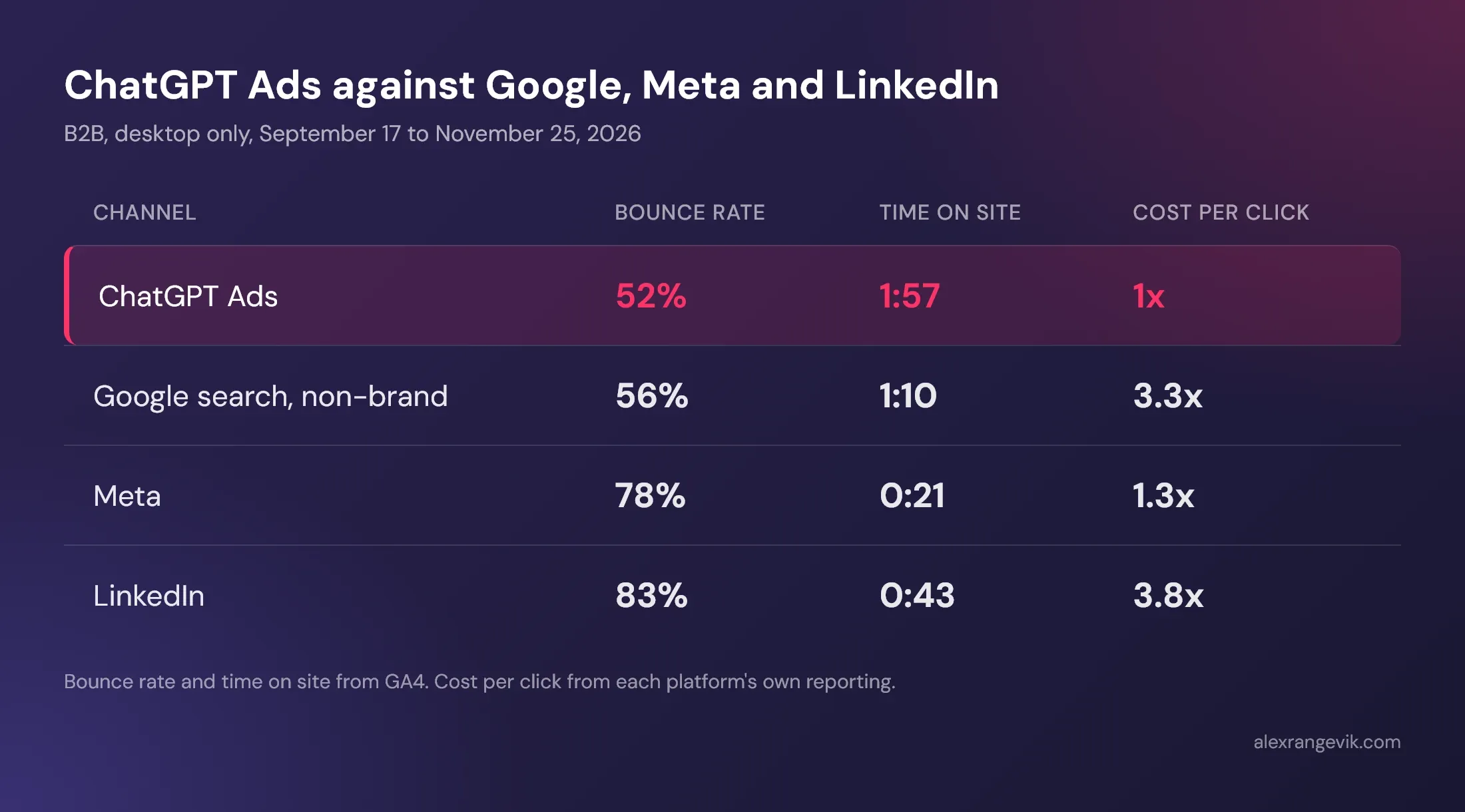
Per click, LinkedIn cost 3.8 times as much as ChatGPT.
The click-through rate came out at 0.86% for the whole period and around 1.15% a week in November. Graphite and Similarweb put the average at about 0.73% between March and September, and in Similarweb's data the top quartile starts at 1.0%. OpenAI says itself that there are no benchmarks yet (so we're all guessing a bit, lol).
Each impression costs 23% more than on Meta, so if you judge ChatGPT on CPM it looks worse than it is. I've broken down what a click and an engaged visit cost in a separate post.
The settings that made the difference
Four things did most of the work: desktop only, context hints written from the ICP, plain ads, and creative enhancements turned off so ChatGPT doesn't rewrite them.
The context hints describe the buyer and the situation they're in, the way they'd describe it to ChatGPT themselves:
"Warehouse manager, operations manager, founder or CEO in ecommerce with in-house fulfillment, at least 10 employees, and a volume of over 300 orders per day, who is actively looking for an automated robotic warehouse solution to streamline picking and packing. They want maximized space efficiency, rapid implementation, and seamless integrations with their e-commerce platform."
People write way more in an AI chat than in a Google search, so the hints can be that specific. They name the roles, the size of the company, the order volume and what the person is actively looking for.
The ads that survived are the plainest ones. The headline is just the product category, and the body is three numbers from the client's site about faster picking, more space and fewer errors. The other versions, built around the brand, a question or a growth promise, were paused within three weeks, and the click-through rate went from 0.29% in the first week to around 1.15% a week in November.
For a new account I'd keep the location narrower too. The whole setup is in my ChatGPT Ads Manager guide.
Check that the clicks come from your ICP
Engaged visits only count if they come from the right companies, so I run IP tracking like Leadfeeder on top. It identifies the companies behind the visits from people who accept cookies, and you check those against your ICP.
It works better than usual here, since the ads only run on desktop web. People on a desktop are mostly at work (or at least pretending to be), so the IP points to the company way more often than it would on mobile.
And the results vary a lot. Umbau in Belgium found almost three quarters of the identified companies in their ICP, while Floyd Blaikie found 5 of 146.
The only independent study so far is also less flattering. Kaiser and Schulze found that ChatGPT ads brought in $0.89 per session against $2.45 for paid Google search, across 102 advertisers in the US. It's a preprint and most of the sites sell to consumers, but it's worth knowing. Ads Manager only reports last-touch too, and Digiday has written about advertisers whose lawyers won't sign OpenAI's tracking terms.
That's also why I don't write them off. In 6sense's global report, the vendor that won was already on the buyer's shortlist on day one in 92% of the deals. Two engaged minutes on your site, months before anyone talks to sales, are worth something even when they don't show up as a lead.
Europe is a different game
Self-serve buying opened across Europe on August 31, 2026. But personalized ads aren't available in the EEA or Switzerland, and custom audiences aren't supported for campaigns that target them. Your ad gets picked from the conversation and your context hints, and that's it.
There's also no independent data on how the ads perform here. Graphite and Similarweb's benchmark covers nine markets and none of them are in the EU, and Kaiser and Schulze used the EU as their control group, precisely because it had no ads.
European buyers use AI less than they did a year ago. In 6sense's European report, the share of buyers using LLMs during evaluation fell from 89% to 71%, and only 22% of them got help finding vendors (1,139 buyers in Germany, France, the Netherlands, Sweden and Belgium). At the same time, 52% of Swedish internet users now use ChatGPT, up from 34% a year earlier.
And you'll see less of it in your reports. Since the client's cookie banner started asking for consent in the EU and UK in August, 34 to 49% of the sessions in the UK, Germany and the Netherlands have no source at all in GA4. AI referrals from those markets have more or less disappeared from the reports, while the leads from them keep coming in.
The organic side is small but good
Organic AI traffic is still under 1% of the client's sessions. That's in line with Ahrefs, who measured 0.46% across 118,670 sites in October, and SE Ranking, who put the EU at 0.27%.
The leads are good, though. This year, contacts that came from an AI assistant make up 2 to 4% of the client's MQLs, SQLs and opportunities from the website. 69% of the AI MQLs became SQLs, against 67% for the other web sources, and they've brought one customer so far, plus two open deals that together are worth 5.8 times a median deal.
About half of those leads showed up only in the "How did you hear about us?" field and the other half only in the analytics data.
It isn't the same everywhere. Leadfeeder found that companies coming from AI matched the ICP 15.8% of the time, against 20.4% for organic search, across 1,200 B2B accounts.
Common questions
Do ChatGPT Ads hurt your organic visibility in ChatGPT?
Not that anyone has shown yet. In Kaiser and Schulze's data, organic referrals dropped 5.9% after ads were introduced, which wasn't statistically significant. And SE Ranking found the advertiser cited in the answer itself in under 4% of cases.
Who actually sees ChatGPT Ads?
Only logged-in adults on the Free and Go plans. Business and Enterprise users never see them, so buyers who use ChatGPT through a company license won't see your ads there.
How much does a first test cost?
The minimum is €15 a day per campaign, so roughly €450 a month for one market. That's about what I run a test on.
Sources checked in November 2026. Client numbers are from GA4, HubSpot and the ad platforms in 2026, with the ads from September 17 to November 25.
Tools from my client work

Related posts
-
 ChatGPT Ads
 Cost for B2B: What Our Tests Actually Cost
ChatGPT Ads look expensive on CPM, but per engaged visit they've cost way less than Meta and Google search in my B2B test. -
 ChatGPT Ads
 Manager: How to Set Up Your First B2B Campaign
Start on engagement conversions and keep the campaign narrow until you've reached everyone in your category who's actually in the market. -
 ChatGPT Ads
 for B2B: What They Cost and Whether to Test Them
In B2B, ChatGPT Ads are really good at bringing engaged visitors, so I'd start testing them now while the platform is new.